
Events10-07-2026
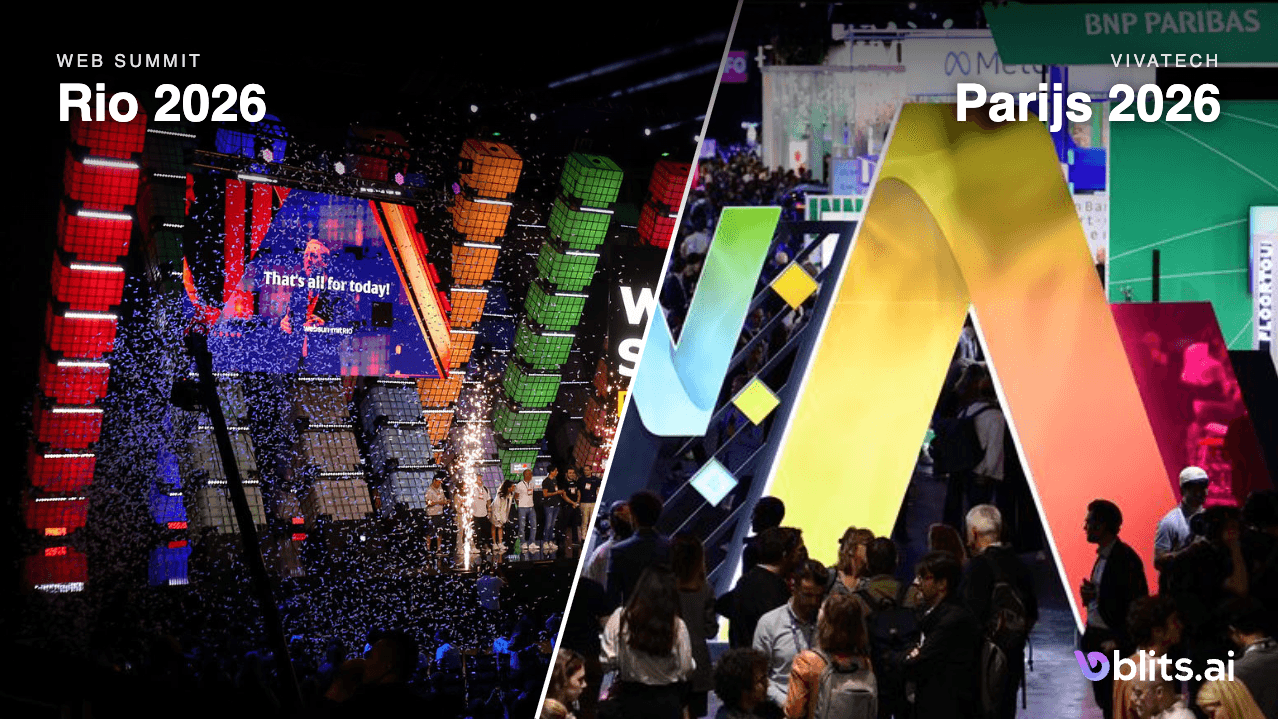
From Paris to Rio: Production Over Pilots, Substance Over Spectacle
Read More →

Last week I flew to Johannesburg for Mastercard's "AI: Intelligence in Action" summit at the Four Seasons Westcliff. The tagline was From Insight to Impact. The room was full of people who don't need convincing that AI matters: executives from Nedbank, Old Mutual's new OM Bank, Standard Bank South Africa, Microsoft, and a handful of companies (including us) building the infrastructure that connects AI to real financial services.
I was there to demo two conversational AI experiences we built on Blits.ai for Mastercard. But the conversations that happened between sessions told a bigger story than either demo could on its own.
Here's what I took away.
There was a visible dichotomy in that room. On one side, organizations already running AI in production, handling real customer queries, powering recommendations, automating back-office operations. On the other, teams that have built AI systems but can't confidently point to the results.
That split isn't about capability. The models are powerful enough. The tooling is mature enough. What's missing is trust, both organizational trust ("do we believe in the outputs?") and customer trust ("do I feel safe letting this thing act on my behalf?").
Agent adoption is shifting from demos to durable workflows. The team that wins is not the one with the most agents. It's the one that knows what each agent does, what it reads, who reviews it, and who is accountable when it drifts.
This is where rigorous evaluation becomes the difference maker. At Blits, we run extensive eval cycles on every agent we build: classifying failure modes, stress-testing edge cases, measuring where the AI breaks and why. Trust doesn't come from a confident demo. It comes from knowing exactly how your agent behaves when the input is messy, the question is ambiguous, or the data is incomplete. You can't govern what you haven't evaluated.
That was the fault line in Johannesburg. The banks that are winning aren't the ones with the flashiest demos. They're the ones that have answered the ownership question.
The technology isn't the bottleneck anymore. Governance is. Who owns this agent, what is it allowed to do, and where does a human step in?
Mastercard's message at the summit was clear: they want agentic commerce at scale. The Mastercard Agent Suite, launched earlier this year and now positioned as "built for African scale," envisions a world where AI agents don't just recommend products but authenticate, transact, and settle.
But here's the nuance. Nobody in that room was naive about what it takes to make an AI agent trustworthy enough to move money. Mastercard has built a credibility layer specifically for agent-initiated payment confirmations, a verification step where the human confirms intent before funds move. Not because the tech can't handle autonomous transactions, but because the trust infrastructure needs to catch up to the technical infrastructure.
This came through loud and clear during the "From Hype to High Impact" panel. Chipo Mushwana from Nedbank, Ethel Nyembe from OM Bank, and Steve Barker from Standard Bank each brought a different lens, but landed on the same point.
Chipo framed it around dual service: the bank of the future needs to serve people directly and serve the AI agents acting on their behalf. That sounds abstract until you realize Nedbank already has 3 million active users on their Money App, selling 90,000 products a month through digital channels. She's not theorizing. She's describing the infrastructure her team is building around, and the trust question is what keeps her up at night. Her take: make banking more personal, but never make it opaque. The moment a customer can't understand why the agent did what it did, you've lost them.
Ethel brought a completely different angle. She joined OM Bank in January to build the product stack from scratch for what Old Mutual calls its "single largest strategic investment." When you're designing a bank from a blank page in 2026, AI isn't a feature you bolt on later. It's a foundational design decision. But even she stressed that the customer has to feel in control. Intelligence embedded everywhere, autonomy handed out carefully.
Steve's perspective was shaped by scale. Standard Bank processes more payments than any other institution on the continent. At that volume, even small trust failures cascade. His concern wasn't whether agents can work. It was how you maintain trust at scale when millions of interactions happen every day and each one carries the bank's reputation.
Three different institutions, three different stages of AI maturity, but the same conclusion: the credibility layer isn't a nice-to-have. It's the product.
Agentic payments aren't a future roadmap item. They're being built now. But nobody is shipping "fully autonomous" to production. The credibility layer is the product.

A theme that kept surfacing in side conversations: many companies have now built their AI systems. The initial build is behind them. The question has shifted from "how do we get AI working?" to "how do we make it better over time without rebuilding it every quarter?"
This is the self-learning pivot. The first generation of enterprise AI was static: train a model, deploy it, hope it holds. The second generation needs to improve on the go, learning from interactions, updating its knowledge base from real usage patterns, and adapting to shifts in customer behavior without a full retraining cycle.
I think about it in terms of eras: Era 1 was the model race (2023-24, who has the best benchmark). Era 2 was the interface race (2024-25, harnesses and tooling). Era 3, where we are now, is persistence and memory, the always-on layer. The model is becoming a commodity. What you own is the context, the memory, and the feedback loop.
For banks in South Africa, this is pressing. Standard Bank processed roughly €8.8 trillion in payments last year and invested over €1.2 billion in technology. That's not a pilot. That's production at continental scale. The question for them isn't "should we use AI?" It's "how does our AI get smarter from every one of those interactions?"
The build phase is over for the leaders in the room. The question now: does your AI learn from last Tuesday, or does it start from zero every morning?
We presented two demos during the "Moment of Action" session.
The Mastercard WhatsApp Travel Assistant puts the full travel booking experience inside a WhatsApp conversation: flights, hotels, restaurants, visa info, payments, all in the customer's own language. And not textbook language, but the way people actually talk: the shortcuts, the slang, the way someone types on WhatsApp at 10pm is different from how they'd write an email. Getting that right is what makes a bot feel like a local assistant instead of a translation layer. But the real hook is card intelligence. The agent knows the user's full Mastercard portfolio and surfaces the right card at the right moment: World card for lounge access before the flight, Bonvoy card for hotel points, Cashback card for dining, Rewards card for points redemption against the total.
The MTN MoMo Agent flips the script on telco service interactions. A customer opens a chat with a complaint ("my data ran out too fast"). Instead of a dead-end FAQ answer, the agent diagnoses the issue, resolves it, and then, because it has access to wallet balance, spending patterns, and payday cycle, pivots into personalized offers: a better data bundle, a savings goal, a cross-border remittance, scam protection, and an autonomous "Smart Auto Top-Up" that monitors the balance and tops up before it ever hits zero.
The Travel Assistant got the strongest reaction. People wanted to test it, not as a demo but as a live onboarding experience. The questions centered on personalization depth: can the agent ask detailed questions upfront, listen to the user, but also draw on historical data the bank already has? Can it infer preferences from past behavior and store new answers in memory for future conversations?
What surprised me was where the audience drew the line on autonomy. People wanted the agent to handle the tedious parts, finding the best flight for this specific trip, comparing card benefits, calculating loyalty point redemptions. But they wanted to stay in charge of the actual vacation decisions. The human picks the destination and the hotel vibe. The agent does the legwork.
For the banks in the room, the excitement wasn't just about travel. It was about the pattern: the ability to expand usage of featured partners, surface in-bank perks and loyalty programs, and create genuine value for the user in the same conversation. The "card intelligence in chat" concept translated immediately from travel to dining, shopping, and insurance.
And there's a dimension that doesn't get enough attention: language and culture. We support over 100 languages on the Blits platform, and we test them continuously. It matters more than most people think. A bot that speaks to a customer in their actual language, with the right tone and cultural register, feels like a helper. A bot that speaks in generic US-English to a banking customer in Johannesburg or Cairo or Riyadh feels like a foreign object that doesn't understand their world. The Travel demo landing in English, Afrikaans, and isiZulu wasn't a checkbox feature. It was the reason people in the room leaned in. When your agent sounds like it belongs in the market it serves, trust follows naturally.
Users want agents that do the boring work brilliantly and then get out of the way for the decisions that matter to them. That's not a limitation. That's the design brief.
If there's one thing that connects everything I heard in Johannesburg, it's this: the technology works. The models are capable. What we're collectively figuring out is where to point them.
I've started calling it the dispatch problem: most organizations have bought AI agents and never figured out what to point them at. That's not a failure of AI. It's a context-matching problem. The same agent architecture that resolves a data complaint for a MoMo user in Soweto can book a holiday to Mauritius for a traveler from Johannesburg. The platform is the same. The context is everything.
At Blits.ai, we've been building toward exactly this. A platform that is secure and certified for financial services. That supports self-learning, so agents improve from real conversations instead of waiting for the next manual update cycle. That can redirect to real humans when the situation calls for it. And that works across channels: WhatsApp, in-app, voice, digital human, whatever the market requires.
But the platform is only half the story. What we've learned from delivering projects across the Middle East, Africa, and Europe is that the hardest part isn't building the agent. It's everything that comes before: which use cases will actually return ROI? What data do you already have, and what shape does it need to be in? What does AI actually need to perform well, and what's just noise?
Most organizations sit on years of customer data, transaction histories, product catalogs, and CRM records. But raw data isn't context. AI doesn't want a data dump. It wants structured, relevant, well-scoped information that maps to a specific customer moment. The difference between a generic chatbot and an agent that genuinely helps is not the model. It's whether someone sat down and figured out what data matters for this use case, how to make it accessible, and what the agent should do when the data is incomplete.
I spend a significant part of my own time testing exactly this: taking a client's raw knowledge base, running it through evaluation cycles, classifying where and why the AI fails, splitting and restructuring the data until the agent actually performs. It's not glamorous work. But it's the work that determines whether an agent answers a customer's question correctly or confidently gives them the wrong answer. The data pipeline is the product as much as the conversation is.
That's where our project experience across banking verticals pays off. We help clients structure the problem before we build the solution: identify the three or four use cases that will deliver measurable value first, map the data requirements, design the conversation architecture, and set up the feedback loops that let the system learn and improve. The platform handles the execution. But the thinking that shapes what the platform does, that's where the real work happens.
The gap between the fast movers and everyone else is widening. Standard Bank invested over €1.2 billion in technology last year. Nedbank is running hackathons on their banking APIs with AI. Ethel Nyembe at OM Bank is building an entirely new bank's product stack with AI baked in from day one. These institutions aren't piloting anymore. They're compounding.
The question is no longer whether AI works in banking. It's whether you have the right context for each use case, the trust framework to let agents act, and the feedback loop to make them better every day.
That's what the room in Johannesburg was working on. And it felt like the real beginning, not of AI in banking, but of AI that banks can actually trust.
Blits.ai is an enterprise conversational AI platform. We build, deploy, and manage AI agents for financial institutions across the Middle East, Africa, and Europe. If you're working on agentic AI for financial services, let's talk.
Get the latest insights on conversational AI, enterprise automation, and customer experience delivered to your inbox
No spam, unsubscribe at any time