
Product Features20-08-2020
15 advanced features that turn your chatbots into gold
Read More →













Why agentic AI is the next operating layer of the enterprise.
For years, we've automated steps. We've automated form submissions, approvals, ticket routing, invoice matching, report generation. If the sequence was predictable, we could script it. If the inputs were structured, we could build logic around them.
And yet, despite all that tooling, most enterprise work still relies heavily on human coordination. Not because the tools are missing. But because traditional automation was built for predictability, and real business rarely is. The friction in organizations today isn't in executing steps. It's in coordinating them. That's where agentic AI enters the picture.
Classic automation systems work extremely well when the world behaves as expected. They assume a stable process, a fixed order of operations, clearly defined inputs, and a limited set of variations. But real workflows don't behave that way.
A request comes in slightly differently. A data source has changed. A policy was updated last week. An exception appears that wasn't considered when the automation was designed. Suddenly, the system stalls and a person steps back in.
Someone checks the ERP. Someone pulls a spreadsheet. Someone compares numbers manually. Someone rewrites the email because the template doesn't quite fit. Someone decides who should handle the issue.
Most enterprise work is not step-based. It's judgment-based.
And that is precisely the boundary traditional automation struggles to cross.
Agentic AI shifts automation from step execution to outcome orchestration.
Instead of predefining every branch of a process, you define the goal and the constraints. The agent receives that goal, plans how to achieve it, interacts with systems, retrieves data, adapts when conditions change, and continues until the outcome is reached, or until human input is required.
That difference may sound subtle, but architecturally it is profound. We are moving from script-based automation to intent-driven systems.
Traditional automation asks: "What is the next step?"
Agentic AI asks: "What needs to be achieved?"
That shift enables the automation of workflows that previously felt too messy, too cross-functional, or too dynamic to justify building rigid process logic around them.
Consider month-end close in finance.
This is not a single transaction. It is a coordination exercise across systems, reconciliations, exceptions, and reporting requirements. Teams retrieve data from ERP systems, compare figures against bank statements and subledgers, identify discrepancies, draft summaries, and prepare documentation for leadership review. The repetitive elements are predictable. The exceptions are not.
An agentic workflow can operate on schedule, retrieve required datasets, apply predefined financial rules, highlight anomalies, assemble a first draft of the close package, and escalate only when irregularities exceed thresholds. The human role shifts from assembling information to validating and interpreting it. The speed improves. The error rate drops. The audit trail remains intact.
Or take sales operations.
When a new lead enters a CRM system, someone typically researches the account, checks internal history, selects the right messaging approach, drafts outreach, and logs the activity. It's not conceptually complex work, but it is coordination-heavy and time-sensitive.
An agentic system can enrich the account with connected data sources, apply the correct industry playbook, draft personalized outreach aligned with brand tone, suggest scheduling options, and log all activity back into the CRM. Sales teams focus on conversation and conversion, not preparation.
In both examples, the agent is not replacing expertise. It is absorbing coordination overhead. That distinction matters.
AI has been embedded into enterprise software for years. Recommendation engines, predictive analytics, workflow suggestions, none of this is new. What changed is reasoning.
Modern foundation models can now plan multi-step sequences, use tools, access APIs, and adjust behavior mid-process. They are not simply predicting the next word in a sentence; they are orchestrating interactions across systems.
At the same time, enterprise demand has matured. Organizations are no longer experimenting with isolated chatbot pilots. They are asking how AI can reshape operating models. The shift underway is from AI as interface to AI as infrastructure.
Research and adoption patterns point in one direction: enterprises are increasingly turning to AI to automate complex, multi-step processes that involve reasoning and coordination, not just simple rules. Gartner has named agentic AI a top strategic technology trend for 2025, describing it as a "goal-driven digital workforce that autonomously makes plans and takes actions." BCG notes that effective AI agents can accelerate business processes by 30% to 50%, and that "companies that embrace agentic AI now will gain a competitive edge in productivity, responsiveness, and innovation."
From answering questions to running processes. That is not a feature enhancement. It is an architectural layer.
The rapid evolution of agentic AI has created a crowded landscape. Every major AI provider is embedding workflow capabilities into their ecosystem. New orchestration platforms appear monthly. This creates opportunity, but also risk.
Enterprises operate under constraints that consumer tools rarely face. Data sovereignty requirements, regulatory frameworks, internal security policies, regional hosting mandates, and language support complexities all shape architectural decisions.
Committing deeply to a single AI provider or tightly coupling automation logic to one model ecosystem introduces long-term rigidity. AI models improve rapidly. Pricing changes. Policies evolve. Regulatory conditions shift. If workflows are built around one proprietary stack, adapting later can become expensive and disruptive.
Flexibility in AI infrastructure is not simply a technical preference. It is strategic insurance.
When building the Agentic AI Studio at Blits.ai, our design principle was simple: control without limitation.
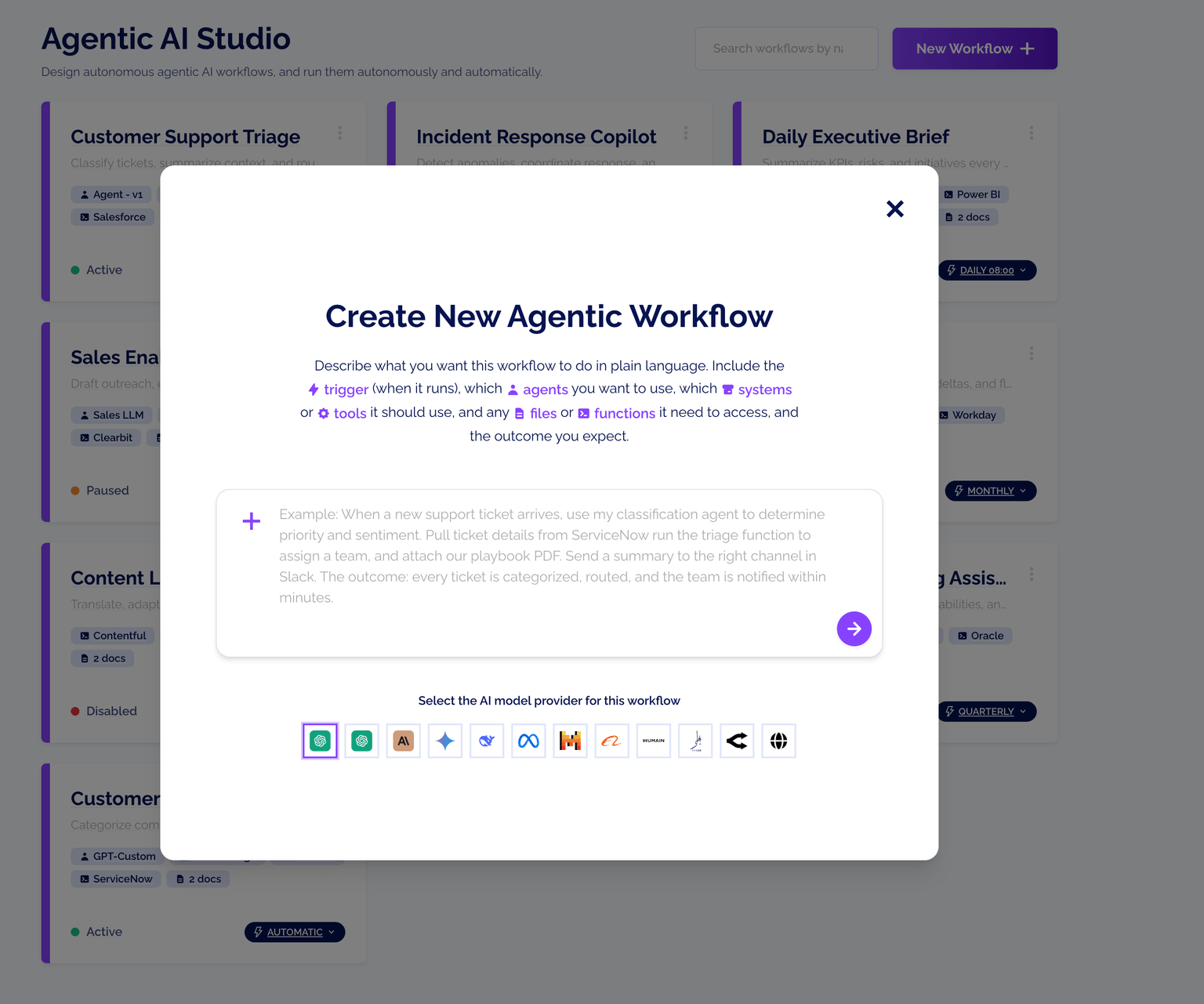
Enterprises need the ability to define outcomes in natural language, connect workflows to existing systems, select appropriate AI models per use case (Blits.ai supports OpenAI GPT, Google Gemini, Anthropic Claude, Meta Llama, DeepSeek, Mistral AI, and 80+ more), and maintain full visibility into execution. They need auditability. They need deployment flexibility, cloud, hybrid, or on-premises. And they need portability.
Model agnosticism is critical in this context. AI capability is evolving too quickly to anchor enterprise workflows permanently to a single provider. Organizations should be able to evaluate models based on performance, cost, language support, regulatory alignment, and policy fit, and change that selection without redesigning every process.
At the same time, governance cannot be an afterthought. Agentic systems must be inspectable. Enterprises must understand what triggered a workflow, which systems were accessed, how data was used, and where human escalation occurred. Responsible automation requires transparency.
The goal is not to chase novelty. It is to build an adaptive automation layer that remains stable even as AI capabilities evolve. The Agentic AI Studio, together with the Knowledge Library, Apps & Integrations, content management, quality assurance, and the broader Blits.ai platform, is our answer for enterprises that want to adopt agentic AI without sacrificing control or flexibility.
Over the next several years, agentic AI will increasingly become the default mechanism for handling coordination-heavy work inside enterprises. Not because organizations want fewer people, but because they want fewer coordination bottlenecks.
Today, much of knowledge work involves routing, reconciling, formatting, escalating, and synthesizing across disconnected systems. These are precisely the kinds of tasks that agentic systems handle well. Humans remain responsible for interpretation, strategy, and accountability. But they are relieved from stitching systems together manually.
The transition mirrors earlier technological shifts. Databases did not eliminate decision-making; they eliminated manual record-keeping. ERP systems did not remove finance teams; they centralized fragmented processes. Agentic AI extends that progression into dynamic, reasoning-driven coordination.
The enterprises that embrace this shift thoughtfully will redesign workflows around outcomes rather than around tool limitations. Those that treat it as a temporary efficiency add-on may miss the broader architectural implications.
The discussion around AI often centers on capability: Can it do this task? Can it replace this function? The more important question is structural. Should humans still be coordinating this process?
If the answer is no, then the solution is not another dashboard or another integration script. It is an outcome-driven orchestration layer that adapts as conditions change. Agentic AI represents that layer.
The shift from AI that answers to AI that runs is already underway. The strategic choice facing enterprises is not whether it will happen, but how deliberately they design for it.
And design, in this context, means preserving flexibility, governance, and control while unlocking a new level of operational intelligence.
That is the frontier.
Contact sales to get access to the Agentic AI Studio and run autonomous workflows on your infrastructure with your models and your data.
Get the latest insights on conversational AI, enterprise automation, and customer experience delivered to your inbox
No spam, unsubscribe at any time