

AI Technology12-05-2025
9 Things I Really Hate About AI
Read More →

The questions banks ask us have changed. Two years ago, almost every first meeting opened with "can you build us a chatbot?". Today it's a transformation lead with a longlist, asking which use cases should go live first, what the ones nobody demos actually deliver, and how other banks sequenced it.
The shift matches the numbers. McKinsey estimates that generative AI could add $200 billion to $340 billion of value to global banking every year, the equivalent of 9 to 15 percent of operating profits. Accenture went further and concluded that banking will be more extensively impacted by gen AI than any other industry, with 73 percent of US bank employees' working time having high potential to be transformed. Nobody gets to those numbers with a widget in the corner of a website. A bank is not one conversation. It's hundreds of processes, and an uncomfortable number of them still run on copy paste, PDF attachments and hold music.
We're 21 use cases in, and counting, delivered for banks and card networks across the Middle East, Africa and Europe, from the front door to the plumbing. This post is the map we draw on the whiteboard when that longlist question comes up.
A chatbot is a channel. A use case is a job. And banking has more jobs to give than any industry we work in.
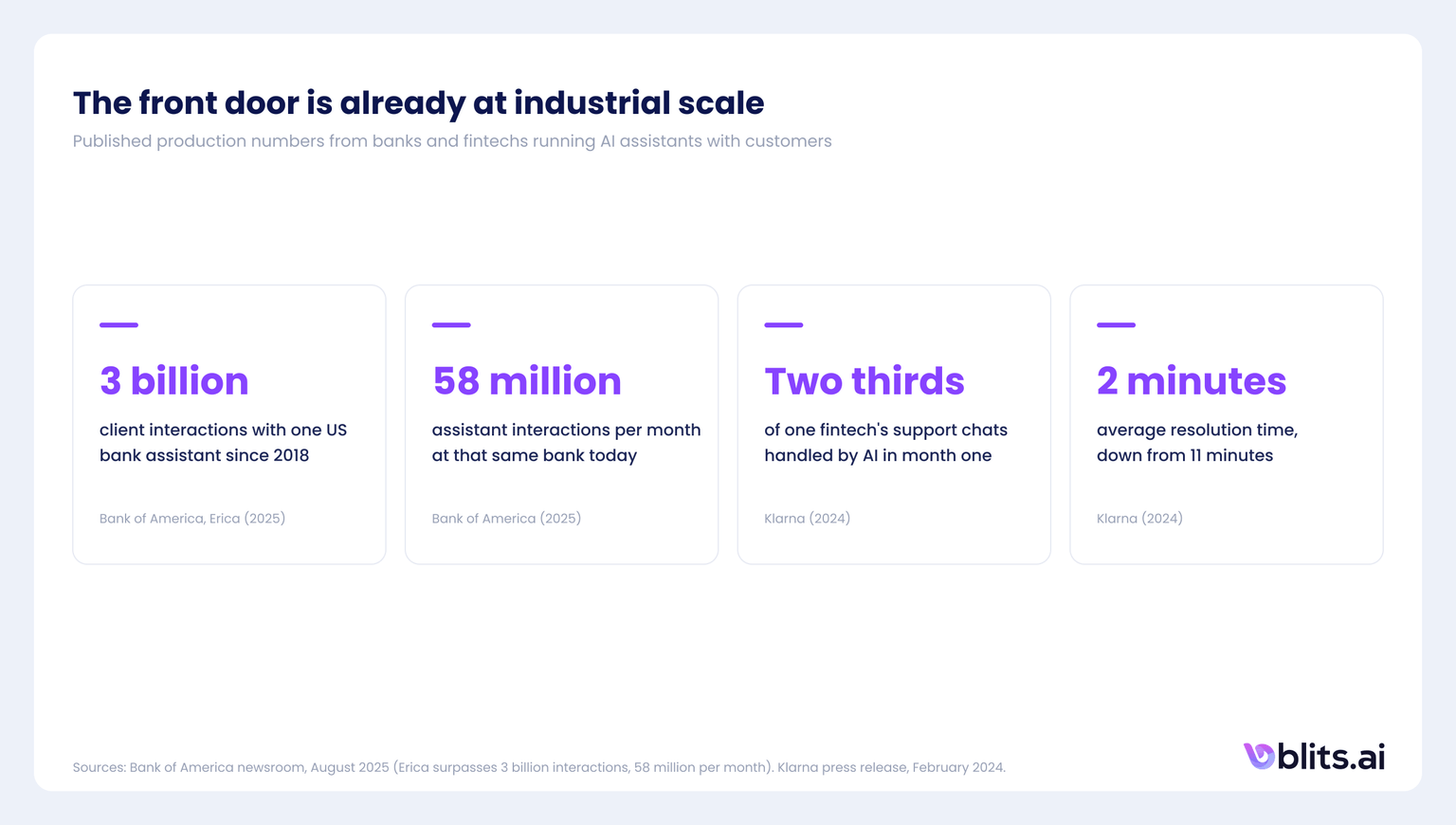
Customer conversations are the natural first step, and the public numbers show how far ahead the leaders already are. Bank of America's assistant Erica has handled more than 3 billion client interactions since 2018 and now averages 58 million per month. NatWest's Cora went from 5 million customer queries in 2019 to 10.8 million in 2023. DBS now runs a gen AI assistant for all of its corporate clients, and Klarna famously reported that its AI assistant handled two thirds of all customer service chats in its first month, doing the work of 700 full time agents while cutting resolution time from 11 minutes to 2.
What those headline numbers don't show is how unforgiving this work is in practice. A banking assistant that is 95 percent right is a liability, and "the front door" is rarely a single door. In our own projects it looks like this:
Voice in the customer's actual dialect. We run telephone assistants for banks that answer in Egyptian Arabic, Gulf dialects and the Saudi "White dialect", not textbook Arabic. And voice has rules of its own: one of our assistants formats every number phonetically, because a text to speech engine that reads "1500" as a digit string will say something a customer on a phone line simply doesn't parse. We've written before about why dialects and voice quality make or break these projects.
Digital humans as the face of the bank. For several banks we run avatar assistants that answer strictly from an approved knowledge base and emit emotion tags with every response, so the avatar's face matches the content: a nod when a customer says thanks, compassion when someone reports a problem. It sounds cosmetic until you watch a customer talk to one. Tone is trust.
Card servicing. Lost card, stolen card, activation. An identity check before any sensitive action, and a handover to a human for the edge cases. Not glamorous, extremely high volume, and with an average inbound call costing around £6.26, the math writes itself.
Offers, loyalty and redemption. This is my favorite underrated use case. Research by Bond and Visa estimated that consumers are sitting on $100 billion of unredeemed loyalty points, and more than one fifth of program members have never redeemed anything at all. We build assistants that filter a bank's offer catalog by card, category and location in the middle of a conversation, and render the results as native carousels in the app. That's not customer support. That's engagement revenue, sitting in a queue nobody was answering.
Financial wellbeing. Spending insights, budgets, anomaly alerts, always showing the underlying math. The assistant that helps a customer understand their money is the one they keep talking to.
Everything above shares one assumption: the customer starts the conversation. The newest requests on our whiteboard flip that. The bank has a list of customers, an offer each of them already qualifies for, and a contact center that will never work through the list. Three new jobs joined the queue while this post was in draft, all of them outbound, all of them voice, and all of them from banks in the Gulf:
Sales lead generation for existing customers. The bank already knows which products each customer is eligible for; that knowledge mostly sits unused in a CRM. The agent calls proactively, recommends only the products the customer actually qualifies for, and captures and qualifies the lead for a human to close.
Card and spend activation. A newly approved card that never leaves the drawer is pure cost: issuance, risk, zero interchange. The agent contacts new cardholders, walks them through activation on the call, and nudges the first transaction.
Credit line increase. An increase offer sent as an app notification mostly dies unread. A short call that explains what the offer means, answers the customer's questions and records the acceptance turns an ignored push message into a signed yes.
The agent is the caller, not the campaign brain.
That line is a design decision, and it's the one that makes these projects land. The bank keeps ownership of contact lists, targeting criteria, campaign rules and eligibility data; all of that comes from its own systems. The agent plugs into the telephony environment the bank already runs (Cisco, in the most recent case) instead of bringing a dialer of its own. And its job stays deliberately narrow: conduct the conversation in the customer's own dialect, capture the outcome, and hand the lead or the acceptance to the workflow that owns it. No campaign management suite, no segmentation engine, no analytics platform pretending to be a marketing department. Note that everything the middle office section below insists on (guardrails, identity checks, an audit trail) applies unchanged here, because an outbound call that touches credit is still a regulated conversation.
The KPI flips along with the direction. Inbound assistants are judged on cost avoided. These three are judged on revenue started: leads qualified, cards activated, credit accepted.
Put everything we deliver for banks side by side and it stops looking like a chatbot project. It looks like this:
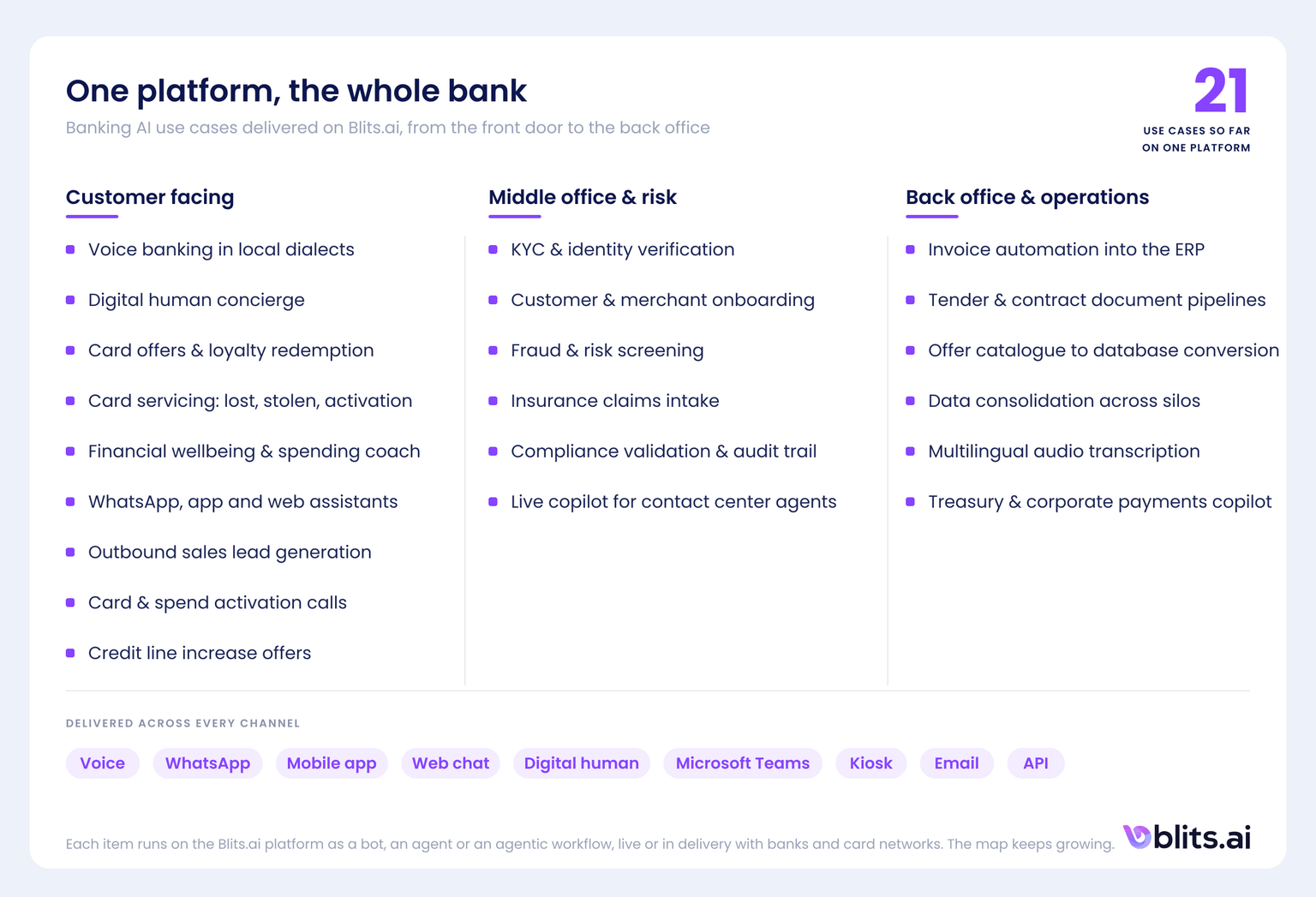
A caveat before we walk through it: this map is a snapshot, not a catalog. It gains rows every few months (the outbound trio is the newest addition), and the newest rows rarely appear anywhere near the chat window. The first column is what gets demoed. The other two are where most of that McKinsey value actually sits. Let me take you down to those floors, because most longlists never reach them.
KYC and onboarding are the clearest example of a process everyone tolerates until they see the price tag. Fenergo puts the average cost of a single corporate KYC review at $2,598, up 17 percent in a year, with UK banks now taking 95 days on average to complete one. The same research found that 67 percent of corporate and institutional banks have lost clients because onboarding was too slow. And on the retail side, Signicat found that 68 percent of European consumers abandoned a financial application partway through.
Look at what onboarding actually is: collecting documents, checking them, chasing people who went quiet, escalating the doubtful cases, keeping an audit trail. That is a conversation problem stapled to a document problem, which is precisely what a bot plus agent combination is good at. We've built onboarding flows where a bot handles the predictable rails, a validation agent checks every uploaded document (is the full passport visible, is the signature there, are all fields filled), reminders go out on a schedule, and a human gets a structured task the moment confidence drops. One design rule we never bend: the validation agent returns decisions, never passport data. It answers "approved" or "rejected and here's why," and the personal data stays where it belongs.
Fraud is the other middle office giant. Card fraud still cost the world $33.4 billion in 2024. AI here is nothing new: an Economist Intelligence Unit survey found that 91 percent of US banks were already using AI for fraud detection years ago. What's new is what the generative layer adds on top: Mastercard reported that gen AI improves its fraud detection rates by 20 percent on average, and up to 300 percent in some cases, while cutting false positives by more than 85 percent. Fewer blocked holidays, more caught criminals.
In banking, the impressive part of AI is not what it can do. It's what it reliably refuses to do.
That line is the whole middle office in one sentence. Guardrails, identity checks before sensitive actions, human review when confidence drops, an audit trail on everything. When we demo this, the compliance team leans in further than the innovation team. That's when you know a project will survive contact with production.
Here's a pattern I see constantly: the AI budget goes to the front office because that's what the board can see, while the clearest business case in the building sits in accounts payable. Ardent Partners benchmarks the average cost of processing a single invoice at $9.84, with best in class teams paying 79 percent less. Processing time shows the same spread: 8.2 days on average against 2.9 days with advanced automation.
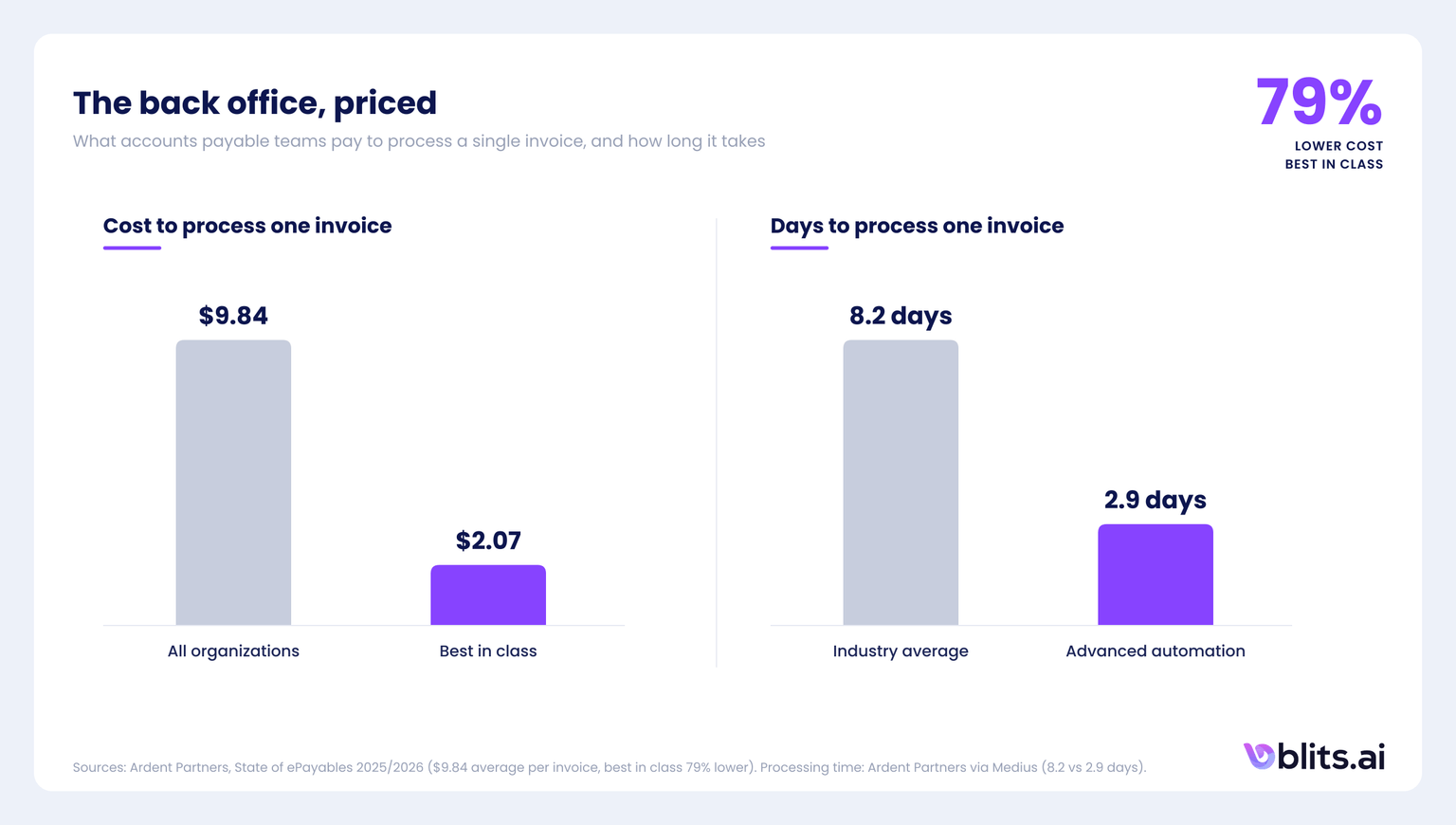
The demo lives in the front office. The business case usually lives in the back.
This is agentic workflow territory, and it's where the platform quietly earns its keep. Invoices come in by email, an agent extracts and validates the line items, matches them against purchase orders, posts the result into the ERP and routes only the exceptions to a human. We run tender document pipelines that read an entire government tender package and produce Excel files ready for submission. We convert offer catalog spreadsheets into clean SQL databases that a retrieval agent can query mid conversation. We transcribe podcast audio into Arabic and English transcripts, consolidate data scattered across decentralized databases, and turn log files into categorized error reports. None of this will ever be on stage at a conference. All of it compounds, every single day.
There's a question we hear more and more from banks in Latin America, the Middle East and Asia, and it has nothing to do with cost savings: how do we get customers to open our app when nothing is wrong? Nobody opens a banking app for fun. The ambition behind that question has a name, the super app: one app where the customer books a flight, orders dinner, arranges insurance and pays for all of it, with the bank underneath every transaction.
The super app question is really an engagement question: what makes a customer open your bank's app when nothing is wrong?
This is not an exotic ambition anymore. Careem's own site calls it building the everything app, serving over 48 million customers across ten countries. WeChat sits at 1.43 billion monthly users. Brazil's Inter runs banking and a full shopping marketplace in one app for 44 million clients, logging more than 20 million app sessions a day. Revolut, 65 million customers and aiming for 100 million, will book your hotel with cashback and sell you an eSIM data plan for over 100 countries right next to your current account. Gartner expects that by 2027 more than half the world's population will be daily users of multiple super apps.
Customers, it turns out, are not the obstacle. Chase's own research found that 86 percent of consumers want one app for all their banking, and 38 percent would rather book travel through their bank. And the engagement math is what makes boards lean in: Inter reports that clients in its loyalty program use 2.3 times as many products as other clients, and at KakaoBank platform and fee income has grown to 37 percent of operating revenue. Time in app is not a vanity metric. It's share of wallet.
Our field observation, having built inside one: a super app without a conversational layer is a shopping mall without a concierge, twelve tabs and a search bar. This is where several rows of our map converge. We've built the travel concierge that knows visa rules, flight routes and hotel tiers inside a regional super app. The food ordering agent that remembers dietary preferences mid conversation and renders the menu as a native carousel. The card intelligence that surfaces the right card at the right moment and redeems loyalty points at checkout. For a bank taking this route, the AI layer is not the tenth workstream on the program. It's the thing that makes twelve services feel like one app, and it runs on the same guardrails, offer pipelines and payment confirmation layer that were already on the map.
Here's the strategic fork most banks hit around use case number three. 21 use cases as 21 separate vendor projects means 21 security reviews, 21 integrations, 21 ways of logging, and no shared learning between any of them. That road ends with an AI landscape nobody can govern.
The alternative is treating use cases the way you treat employees: different jobs, one building, one set of house rules. On Blits.ai, the voice assistant, the KYC workflow and the invoice pipeline share the same knowledge bases, the same guardrails, the same audit trail and the same test suite. When a new model comes out, we swap the engine per job and prove nothing broke by replaying real conversations against it. When an agent is allowed to touch money, it goes through the same confirmation layer we described when AI was first allowed to spend money by itself. And every use case reports into the same KPIs, because a use case without a number attached is a hobby.
The market is moving this way fast. Temenos found that 75 percent of banks are exploring gen AI deployment, with 36 percent already deploying or in the process. The question for most banks is no longer whether. It's in what order.
My honest advice, after watching this go right and wrong at many banks: pick one use case per floor.
Then resist the urge to celebrate. Measure, publish the numbers internally, and let the second wave ride on the infrastructure the first wave already paid for: the knowledge bases are built, the integrations exist, the governance is in place. That's how 21 use cases stop being 21 projects and start being one capability.
The flashiest chatbot rarely belongs to the bank that's winning with AI. The winners are the ones that noticed the queue of jobs behind the chat window, answered the governance question early, and simply started working through the queue.
We'll happily draw this map on your whiteboard, including the floors your customers never see. By the time we do, the number probably won't be 21 anymore. Let's talk.


Get the latest insights on conversational AI, enterprise automation, and customer experience delivered to your inbox
No spam, unsubscribe at any time